Sunday, May 04, 2008

Finishing the Baritone Guitar

One of the final stages of a guitar’s construction is gluing the bridge in place. All the varnish, lacquer, whatever has to be scraped off of the soundboard, back to bare wood so that you get a good glue joint between the two surfaces. Get this wrong and you wreck the guitar!!
The positioning of the bridge has to be spot on. I’m sure that most people who are reading this will know that the bridge’s saddle has to be set back further than its theoretical positioning order to get the intonation correct. The longer the scale length the further back the saddle has to be.
Now that distance i.e. between the theoretical position and its actual position was, for the baritone and its 685mm scale length, “a known unknown.”
So I built this....

....I call it my Rumsfled jig: it allows me to experiment and find out known unknowns! By sliding the movable saddle back and forth, I can find the ideal position for the saddle for any combination of scale length, string gauge and pitch.

With the distance found out the position of the bridge can be ever so carefully marked out, the lacquer scraped off and the bridge glued on.

Some fine tuning (literally) later and we have one completed Baritone guitar ready for collection!

Sunday, April 20, 2008

Beautiful Tonewood. Don’t you just love wood!!

In the photos below you can see some beautiful tonewood that I have just got in.
Here are two sets of rippled Claro walnut; these are going into stock for future commissions and will make someone a great looking guitar some day.


Below is some Snakewood, you can see from the grain why its called Snakewood! This is for a steel-string guitar that I shall start building as a commission later in the year. Head overlays, fingerboards, bindings and bridge blanks. I’ve also got a big bag of Paua shell for it, it’s going to be quite spectacular...watch this space.

Labels:

Saturday, April 05, 2008

Building the Mandocello

The baritone guitar is going through the final finishing stages and you can see it below.


The real work on the mandocello has now started; it’s an interesting build, so I thought I’d put a fair bit on the blog about it. Firstly its shape, in an earlier blog, I mentioned the Music from the Woods of England project and I proposed an unusual shaped guitar for it. See below.

When Andrew and Jane approached me about building them a mandocello, this shape immediately sprang to mind. When I did the original drawing, I decided that I didn’t want a shape that looked like it belonged to a particular time or place. Also I’ve always felt that the best place for the bridge of an instrument is the centre of the lower bout. These two factors got me sketching and hence the idea evolved. I’m very grateful to Andrew and Jane for going with this design; all artisans need patrons with some vision.

With 8 strings and a narrow neck, I’ve decided to reinforce it with two strips of carbon fibre and an adjustable truss-rod. I’m becoming much more confident with the carbon-fibre, the neck of the bass that I recently completed for my son is supported in exactly the same way and it hasn’t moved at all and that’s without the adjustable rod being tightened. I’ve taken the carbon-fibre right through the head joint which will greatly strengthen this area too.


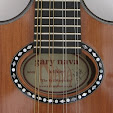
The soundhole is oval so I had to make up a jig in order to cut the channel for the rosette and the hole. Being oval, each piece of mother of pearl had to be shaped individually to fit.


For the sides I’ve made up the external mould in four sections. It’s a bit odd cutting the sides into short sections before bending them, you keep double checking before sawing them! The back and sides are being made from some really beautiful English walnut.


Once the sides were bent, the four pieces are joined together by blocks of wood. The tail block is made from plywood. This going to have a hole drilled through it for a jack socket and the tail-piece attached to it; ply is the obvious choice so that it doesn’t split.


These heavy duty rubber bands and strips of plywood are a very effective way of clamping the awkward shape of the sides into the mould. Also they help to keep the overall weight of the mould down. The mould plus a dozen clamps gets extremely heavy and you run the risk of dropping the lot as you work on the sides.


All the other blocks are made from Honduras Cedar; it’s both very light and extremely stable. The linings will also be made from Cedar. Another reason for using Honduras Cedar or “Cigar box cedar” is that it gives the inside of the instrument a nice aroma; how’s that for attention to detail, worrying about how your instrument smells!


Labels:

Sunday, March 16, 2008

Carving the inside of the Archtop


I thought that I would show you the next step of carving the archtop. With the outside profile more or less there, the inside is carved out.

The first step is to drill a series of holes to give me a rough guide to depth whilst carving. I’ve set up this post on the pillar drill, the outside profile of the top sits on it. The drill is set so that it stops 8mm away from the post.


I can now drill holes all over the inside of the top and they will stop 8mm from the outer surface, this gives me my rough guide.


The next step is to sharpen up the gouge and plane and get carving!

This is going on whilst the baritone is being sprayed and it’s looking really good! I’m also preparing the wood for the mandocello, doing some design work for the cittern and sourcing some exotic materials for the left-handed cutaway steel-string. Any one got any Snakewood!


Tuesday, March 11, 2008

Magazine Article


This month I’m featured in the Richmond Magazine: it’s a glossy lifestyle magazine for the area that I live in. Ironic really as I don’t have a glossy lifestyle! Joking aside, I’m really pleased with the article. The journalist, Tanya Reed, did a really good job; she managed to take my technical ramblings and write an article of general interest. I’m also pleased with the amount of room that I got. So a BIG thank you to all at Richmond Magazine!!

Sunday, March 02, 2008


Interesting Commissions

Things have been quite busy lately so I haven’t had many opportunities to update the blog.
The twin point mandolin has now been sold and has found a home in the Western Isles.
It’s always a worry sending an instrument so I built a crate for this one and I was glad to hear of its safe arrival.
Its new owner Ruaridh seems to be very pleased with it and has said some nice things. I guess he must like it, as we are currently discussing me making him a cittern!
All my recent commissions seem to be for less ordinary instruments: a baritone, a hybrid archtop, a mandocello, left-handed cutaway steel-string and a possible cittern!
It’s always exciting getting a commission and going through the design process with a new client. These less usual instruments give you a great opportunity to develop your knowledge as a luthier.

The photo below shows the baritone in the middle of being fretted, the neck has now been shaped and it just needs a major clean-up before spraying.


Making an Archtop guitar (my way!) Part 2


I’ve reshaped the profile of the archtop. I used a Wagner Safe-T-Planer to create a consistent 6mm rebate around the edge and reshaped the profile to blend it in. You can see below the Planer look quite vicious.


It’s set 6mm above the bed of the pillar drill and piece of 6mm plywood is clamped in place to act as a guide. You then feed the top into the spinning cutter, although it’s a bit nerve wracking at first it does work remarkably well.


You can see the finished rebate below.


Walnut for Mandolins


As the mandolin was going out, I got this batch of walnut for mandolins; 3 sets of English and 2 of Claro. It’s beautiful stuff and will make some stunning instruments. But not yet! It will spend the next year at least in storage and then a few months in the workshop before I start work on it. You have to make sure that your wood is dry and stable before making with it.

Sunday, February 10, 2008

Luke's Short Scale Bass


As you can see the short scale bass built for Luke is now completed. Luke is really pleased with it and he will be using it with his band, “Hands on Heads.”
One aspect that I’m particularly pleased with is the amount of subtle detail, such as the green lines in the laminations which go unnoticed until you pick the instrument up and examine it. I think I would describe my approach as “making an electric guitar for grown-ups.”

I finished this bass in Tru-oil, which is something new to me, although I know a number of US luthiers use it. It’s an oil based finish that has been formulated for gun stocks and is therefore presumably resistant to all manner of chemicals and weather conditions. So it will be interesting to see how hard-wearing it is.

The Tru-oil finish has a similar visual and tactile qualities to French polish. The obvious difference between the two is that with Tru-oil, the grain is not filled and on woods like the ash of this bass’s body, the grain is still very much open and natural looking.

Ian's Baritone Guitar

Ian’s Baritone guitar is progressing nicely and you can see that the body is together and is ready for the rebates for the purflings and bindings to be routed. The English walnut looks stunning, so I can’t wait to see what it will look like with some finish on it .