Saturday, September 24, 2011

Standard Mandolin II

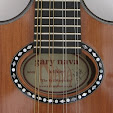
Standard Mandolin II is now completed and very nice it is too!

Sitka spruce soundboard, koa back and sides bound with rosewood, maple neck with a koa head overlay, rosewood fingerboard, rosewood bridge and of course that tailpiece.

I love this back!!

One thing that I’ve changed on this mandolin is the finish. Most of you who follow my blog, know that I’m a great advocate of Tru-oil, however on this (and subsequent mandolins) I’ve used an open pour satin shellac finish. It still has the wonderful smooth feel and natural appearance of the oil, but being shellac based I think that it looks even better.

So what is this “open pour satin shellac finish” then? Well, I’ve started French polishing with a modified shellac polish- that’s a polish that contains Ethyl Cellulose. It’s still applied in the traditional way, but is a generally more resilient polish. Whilst I was French polishing with it, it became clear to me that if I could apply this material in a similar way to the Tru-oil I should get a similar finish.

What are the advantages? Well, I’ve always believed that shellac diffracts the light in a certain way which greatly enhances the appearance of the wood.

The Ethyl Cellulose gives a resilient finish.

I generally prefer spirit based rather than oil finishes as they are not absorbed into the wood.

Also I have found that Tru-oil can take a very long time to dry on resinous woods such as rosewood.

Once the finish has hardened the satin appearance is created with micro-mesh abrasive and 0000 steel wool and then a couple of coats of museum quality, microcrystalline wax polish are applied. Hey presto a very pretty mandolin!

It will soon be on its way to Kevin. I’ve never been one for customer endorsements, you know, “Mrs B of Cleethorpes loves our double glazing.” But Kevin’s Dad has one of my twin-point mandolins, so that’s endorsement enough for me!

Labels: , , ,

Wednesday, August 24, 2011

Ebony bindings

That was hard work! I’ve just finished the ebony bindings on Chris’s Hare. I use 50m of cloth tape to hold on the bindings whilst the glue dries and I glue on one binding at a time; so it takes awhile. Once the guitar is unravelled from its cocoon; it’s clean-up time!

Without doubt, the best tool to use for this sort of task, is a cabinet scraper- if you’re unfamiliar with them, its that rectangular piece of hardened steel, in the photo below.

The other tool is a burnisher, which is used to sharpen the scraper by putting a burr on its edge. That burr, if you get right, will take a shaving off the wood without tearing up the grain. If you’re serious about woodwork, you must master the scraper! It’s flexed between your thumbs thus....

At this stage I try to get the body really clean and get any tiny imperfections sorted out. For example, any tiny hairline gaps between the bindings and the sides need to be filled, especially if you French polish as the finish will accentuate them. Hence wearing a head magnifier whilst cleaning up.
Three hours later.....

The scraper is also used one the front- if you use just abrasives, you increase the possibility of grinding dust from the bindings into the relatively soft soundboard.

As I said, this Hare Signature is for Chris and I’ve added a link at the side for Chris’s Ceilidh Band, Whirligig.

Standard Mandolin II

I’ve been spending a bit of time on t’interweb looking at other luthiers’ sites. Mainly at looking mandolins- one thing that strikes me, is the puny looking dovetail joint for the neck. Clearly they work else there’d be thousands of angry bluegrass players about, with their mandolins in two pieces. I’ve just glued the neck on Standard mandolin II and thought that I’d show my joint.


As you can see, I use a fairly hefty mortise and tenor joint. There is a mass of surface area for gluing and I’m confident that this baby is built to last!

You can see the Koa back, bound in Indian rosewood, nice eh?


Labels: , , ,

Sunday, August 14, 2011

Grain Filing amongst other things


Grain Filing!

I’m just recovering from spending far too long filing the grain on Alan’s rosewood model 1! Well, I say far too long but it is one of those jobs that you just keep going at until it’s done and in reality time spent filing the grain, is time saved when polishing. The trouble is, that it isn’t a very interesting or challenging task and physically you can only do a few hours a day otherwise you risk RSI by constantly applying downward pressure and moving your hand with a circular motion. Ibuprofen cream is an essential part of any French polishers kit! I have tried other types of filler but the traditional pumice method still, for me, produces the best results. You can see the before and after shot above.

Alan’s guitar is now starting to look shiny!

Hare Signature II

You can see that Chris’s Hare is coming together; the body has now been assembled and next week sees the binding and purfling go on.

Standard mandolin II

Also Standard mandolin II is progressing. Those who follow my blog will know that I’m a great advocate of solid linings. I generally bend two strips of Spanish cedar which are then glued together, however, what I’ve done this time is a kind of stepped lining- still two pieces glued together but the inner strip isn’t as tall- why? I still get the surface area for gluing and the stiffness to the rim that I want, but save a little weight. Big deal, you say- but I like to progress in small degrees.

Standard II’s body also went together this week and you can also see the neck blank- I’m going for a maple neck on this one with a Koa head overlay- should look pretty! Under those mahogany fillets is carbon-fibre.
I had intended making this mandolin with a Douglas Fir soundboard- I’ve had one knocking around for years, it’s incredibly stiff so I though that it would be great for a mando. However, having thicknessed it, cut the soundhole etc resin started to come to the surface rendering the soundboard useless! I’m only too glad that I hadn’t inlaid some fancy pearl rosette! You live and learn.

Labels: , ,

Saturday, July 23, 2011

More stuff (I'm running out of imaginative titles!)

I was asked awhile ago, how I was getting on with my cabinet makers vice. Well, it’s fair to say that it has transformed the way that I work; why? Quite simply you can do this!
I got mine from Rutland Tools- they often have a 15% off sale- keep an eye open!

You can see that Alan’s model 1 is now fretted and hopefully all the woodwork should be completed next week. Chris’s Hare is coming along nicely in the background and I’ve just started bracing the soundboard.

As you can see I’m not a go-bar man! At the moment, I prefer to use clamps to apply pressure. The Klemmsia clamps that I use, with their cork lined jaws and lever action, apply just the right amount of pressure, without any damage to the wood. I think that go-bars must be great if you apply a lot of braces in one go, but I prefer to do a couple at a time; shape them carefully and go on to the next ones. It might take me 4 days to fully brace a soundboard, but I’m not in a hurry!

John came up during the week to look at his Koa and discuss the guitar that I’m going to build for him at the beginning of next year. I’ve added a link to John’s YouTube channel on the side bar; he does some very entertaining comic songs. It occurred to me that I’ve not used Koa before and as it’s so expensive.............

The first of my “Standard” mandolins sold last weekend and it now lives in Scotland, with its new owner Brian, who sent me a delightful email about how pleased he is with his new mandolin. So “Standard” No. 2 is underway, and this one will have Koa back and sides!

Interesting stuff Koa it has a similar texture to teak but is much lighter. My main concern was bending the sides, but it proved to be reassuringly easy- you only have to show the Koa the bending iron and it practically bends itself!

Putting the Koa through the sander, I kept wondering why the saw marks wouldn’t go, but then realised it was the figuring. I think that once there is some finish on the wood it will look quite beautiful. I hope to complete this one during the autumn and will be offering this one for sale too.

Labels: , , ,

Thursday, February 24, 2011

Ebony bindings

Ebony is currently the material that I favour for bindings. The main function of the bindings on a guitar is to protect the edges from any damage so, of course, a very hard wood such as ebony does the job admirably. Also, from an aesthetic point of view, it clearly defines the shape of the guitar and for want of a better term, looks very classy.

I had been using a supply of ebony off-cuts that I was given but I knew that I would run out of them, so a while ago I bought a fair bit of ebony from my supplier in India.

Geoff’s OO is the first instrument that I have had to use it on. When I got the ebony out of stock it seemed such a shame to cut these beautiful pieces of jet black wood up “just for bindings.”

It took quite awhile to prepare the strips to the correct dimensions, unfortunately the supplier in India didn’t have the facilities to machine them to my required finished size.

Once to size, you have to bend them. Ebony does bend on a hot iron remarkably well and it’s at this stage you start to appreciate using good quality, straight grained, crack free ebony! You can also see that I use the traditional method of clamping the bindings in place with a fabric tape.

Looks good eh?


Wood with Strings

If your reading this blog, then you’re clearly interested in guitar construction- have a look at Peter Brown’s blog; Wood with Strings (there’s a link on my side bar). Peter refers to himself as a hobby builder, but you’ll have to agree he does some very nice work, all of which is meticulously written up. Also all credit to him for being honest and calling himself a hobby builder. I’m not too keen on guys, who build instruments as a hobby, calling themselves luthiers. If lutherie is your source income or you were trained in the art- fine call yourself a luthier, other than that you’re miss-leading potential customers and devaluing the work of “full-time” luthiers. When I had motor-bikes I used to maintain them myself, but wouldn’t have called myself a mechanic.

Koa

I’ve just got in this Koa wood. It’s meant to be a six piece set for a ukulele, but I think that I should be able to squeeze out two mandolins. This will be in the future though; I want to keep the wood until I’m sure that it’s dry stable enough to work with. I always seal the end-grain of any new wood with wax and now I also run some thin CA over the surface, towards the end of the board, so any hair-line cracks are sealed and don’t spread.

On TV

Have you seen that advert for O2 mobile phones with the guy playing what looks like an original Panormo guitar? Wierd!


Labels: , , , ,