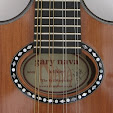
How to make a wood rosette
Over the past few years, I’ve made quite a few instruments with “wood rosettes”; they seem to be a popular alternative to abalone or plain lines. The grain of the wood ensures that each rosette that you make is quite unique and it’s relatively easy to get hold of small billets of exotic woods that can be used to make up stunning rosettes. Anyway, I thought I’d show you how I make mine.
I’ve been making burr walnut rosette for Jonathan’s 12 fret steel-string cutaway.
Firstly, I cut thin book-matched slices from a solid billet of burr walnut; commercially made, knife cut veneers are only 0.6mm thick which, I feel, doesn’t give you enough thickness to play with. Another alternative is to use the off-cuts from the back or sides and I’ve done this on rosewood guitars to good effect.
The thin slices are stuck together (edge to edge) with a waterproof glue and then temporarily fixed down to a work board with hide glue (water soluble- see where I’m going with this?).
 I use the router, with my compass attachment that I made for it, to cut the recess that the rosette will be inlaid in to. Jonathan has requested a Sitka spruce soundboard and this board is a very nice one with lots of medullary rays- these are what give the soundboard that silky looking effect that some players drool over.
 With the recess cut, lines of purfling and veneers are glued in place for the inner and outer rings.
  Once the lines have been glued in, I carefully measure the gap in between them and then use the router again to cut out the walnut circle. Next comes the fun part; using a hot knife and water to lift the ring off of its backing board without breaking it!
  Once the ring is off, it can be glued in place and then cleaned-up; you have to be careful not to grind dark wood dust into the light soundboard.

 Here we have one burr walnut rosette! On with the bracing........

I’ve been making burr walnut rosette for Jonathan’s 12 fret steel-string cutaway.
Firstly, I cut thin book-matched slices from a solid billet of burr walnut; commercially made, knife cut veneers are only 0.6mm thick which, I feel, doesn’t give you enough thickness to play with. Another alternative is to use the off-cuts from the back or sides and I’ve done this on rosewood guitars to good effect.
The thin slices are stuck together (edge to edge) with a waterproof glue and then temporarily fixed down to a work board with hide glue (water soluble- see where I’m going with this?).
I use the router, with my compass attachment that I made for it, to cut the recess that the rosette will be inlaid in to. Jonathan has requested a Sitka spruce soundboard and this board is a very nice one with lots of medullary rays- these are what give the soundboard that silky looking effect that some players drool over. With the recess cut, lines of purfling and veneers are glued in place for the inner and outer rings. Once the lines have been glued in, I carefully measure the gap in between them and then use the router again to cut out the walnut circle. Next comes the fun part; using a hot knife and water to lift the ring off of its backing board without breaking it! Once the ring is off, it can be glued in place and then cleaned-up; you have to be careful not to grind dark wood dust into the light soundboard. Here we have one burr walnut rosette! On with the bracing........
Labels: Luthier, walnut, wood rosette
posted by Gary Nava, Luthier at 1:59 pm
3 comments