Tuesday, October 16, 2012

Standard Mandolins?

I’ve had a few emails from people wanting to know what’s happening with the Standard mandolins, well… here’s an update for you.
First, the Standard Plus: the body has now been fully French polished and whilst that is hardening off, I’m applying a few coats of Tru-oil to the neck as I want to go for that “speed” neck feel. In all truthfulness, the raw wenge neck has such a wonderfully smooth and hard texture that you could get away with no finish. The wenge with a coat of oil on looks like dark chocolate- good enough to eat! Although, the photo doesn’t do it justice!
 Anyway, my intention was to offer this one up for sale once it had been completed, but it’s already been snapped up and will be off to James in the West Country in a few weeks’ time.
 As far as the standard “Standards” are concerned, number IV has been pre-order by Tristan; this gave him the opportunity to choose the tonewood for the back and sides.  With the current interest in my mandolins, I thought that I’d build three at the same time and so I have been preparing the wood whilst waiting for the glue to dry on John’s and the polish to dry on Sean’s twin-points!
 So what we have here are the three backs; English walnut for the next Standard Plus, figured maple for Tristan’s Standard and Brazilian mahogany for Standard V.
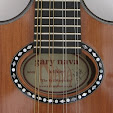
All the soundboards are from some very nice, stiff European spruce. The two Standards have the sound holes bound whilst the Plus has a rosette- this one using walnut in the centre.
Prepping three soundboards together brought home to me how much extra time is consumed making a rosette. As you probably know, with the Standard mandolin, I try to save time in order to reduce the cost to the customer; believe it or not this rosette took around three to four hours to do, so whatever your rate of pay, hopefully you can appreciate my rationale.
And as you can see I’ve also been prepping wood for the necks. As always laminated for extra stability, the Standard plus has green and walnut laminations to match the rosette, Tristan’s maple and rosewood to match the body’s tonewoods, and simple black lines for Standard V. By-the-way, the heads haven’t been glued on here.
 Here’s the spliced head going on Tristan’s.
If you’d like one of my standard mandolins you can pre-order by contacting me, via my website. 

Labels: , , ,

Monday, October 18, 2010

Jonathan’s cutaway completed

Jonathan’s cutaway steel-string is now finished and you can see the result below. I’m certainly pleased with it and have enjoyed having a play on it. The 12 fret, cutaway format works extremely well- one immediately apparent advantage is that the nut is closer to the waist so your left arm does not have to stretch as far whilst playing.

Hand made guitars always take a period of time to “play in” and “open-up”; I think that’s particularly true of Sitka tops (like this one) and I’ll be interested to hear this guitar in a few months time. However, some of you may have noticed a new gizmo called a ToneRite which plays the guitar in for you?? Now, I haven’t tried one, so I’m in no position to comment but.....one thing that I do notice is how the tone of a guitar improves considerably over the first week or so, just by being strung up and subjected to the tension of strings. Well, mine do anyway! And when I played Jonathan’s this morning it had clearly improved, just by sitting, strung up, in a case.

What’s interesting, is that more guitar players come to me now with a very clear idea of what they want. Usually they have taken part in forums and generally picked up a lot of information on-line. Jonathan’s guitar is very much a product of this process- choice of tonewoods. 12 fret neck, cutaway, long scale etc. Fortunately, in this case, Jonathan’s ideas were pretty much in-line with mine and I feel that the result is a real thoroughbred rather than a camel! When I look back over the past 30 or so instruments (that’s about as far as I can remember!) no two are the same and looking forward (on my waiting list) that trend continues.


Labels: , ,

Wednesday, July 28, 2010

Jonathan’s 12 fret steel-string


Here is a little bit about Jonathan’s steel-string; one of the projects that I’m currently working on. This is very much a subtle custom build. Although the guitar is based on my Model 1 shape, Jonathan wanted a 12 fret neck.

As I’m sure many of you know, it has long been the common view that 12 fret necks “sound better” than 14 fret necks as the bridge is positioned more towards the centre of the soundboard. It’s certainly true on this guitar that the bridge is closer to the centre. But if you look at how many classic American guitars have evolved, I don’t think the same can be claimed. Look at early Martin 12 fret dreadnoughts and compare them to the 14 fret neck version, you’ll see that rather than the bridge position moving south, the shoulders are squared off giving a smaller upper bout. The same is true of the 000 and other models. Some may argue that the larger upper bout increases the physical volume of air inside the guitar and that enhances the tone. However, I do think that it is the position of bridge, moved towards the centre of the soundboard, that will really make an audible difference (as of course, does Jonathan!)

So, having decided upon a 12 fret neck, Jonathan also asked for a cutaway to enhance access to the upper frets. I’ve made quite a few 12 fret cutaways in the past and feel that this is an excellent arrangement.

You have to continually evaluate and improve your guitars and something that I had wanted to do for a while was to extend the carbon fibre neck stiffener into the body and Jonathan’s is the first one that I’ve incorporated this idea into. (I’d been trying to figure out how to route the slots!) The CF is glued into the neck block and the neck itself and runs across the neck/body joint. This must increase the rigidity of the joint and to my mind improve the guitar’s performance as vibrations can’t be absorbed. Also, it should eliminate the possibility of distortion of the fingerboard over the body joint that can happen over a prolonged period of time.


Labels: , ,