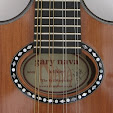
I get, on average, an enquiry a month asking either for a job in my workshop or advice on how to be a luthier. So, I thought that I would write some thoughts on this process to refer any future enquiries to.
Firstly. I understand the romantic appeal of wanting to be an artisan producing musical instruments, working with wood etc.

When I was about 14, I remember seeing an article on the Nationwide TV magazine program about Tony Zemaitis. Pop luminaries such as Eric Clapton and Ron Wood were going to his house and ordering guitars and I though that’s the life for me. I knew by that tender age that I wasn’t going to be a good musician (my YouTube videos prove this!) but I was good at woodwork and the rest as they say is history.
Tony Zemaitis
 Link to info about Zemaitis.
So you want to be a luthier? One of the first things that I think you should do is some maths. Have a look on luthier supply websites and price up the materials for an instrument. Then have a look at the prices that luthiers charge, sure there are some UK makers like Sobell or Fischer who can command high prices, but most (like me!) charge modest amounts. If you’re lucky, you might be able to make (and more importantly sell!) around 10 to 15 instruments per year: factor in tax, workshop overheads etc and that should put you off of the idea! You’re not going to get rich being a luthier! That’s the tough love bit!
My advice is to try to make one at home, by yourself to see whether or not you catch the bug. You’ll need some specialist tools such as a bending iron and router, but these can often be picked up on eBay; use them and if guitar making is not for you sell them on to the next would-be. There are loads of good books and many web-sites showing how to build a guitar so there’s no shortage of information available.
Having made your first instrument you can either continue making by yourself selling to friends, fools and family until you’re confident that your product is as good as anything available.
Trying to price your work is difficult; you cannot say my plumber charges £50 per hour, a guitar takes 100 hours to build therefore I want at least five grand! The price will be a complex combination of your reputation, quality of work and most importantly, what the market will bear.
Alternatively, you could try to get work in one of the few small factories that are about, although I imagine the competition is tough or go to a luthier school and train properly. Even once you have been down this route there is no guarantee that you will make a living.
There isn’t an easy route into guitar making and it takes years to build up a range of skills and a good reputation. I was lucky enough to go the London College of Furniture and train there for three years, at the same time as doing repair work for a local guitar shop. Repairs are a great way to learn about guitars. Those are my thoughts for what they are worth, good luck to you.
So what’s happening in my ‘shop. Well the two Blackwood instrument are coming along; I love this photo! Maybe I should make Russian dolls!

And the Red Mandolin is being French polished. The more I polish the more I like it; I’ve said it before and I’ll say it again, the shellac really brings the wood to life. There is such variation in the grain of the Brazilian rosewood, on the mandolin’s back, that wasn’t apparent until the polish started going on; the shellac must have some optical properties that I’m unaware of.

The mandolin really has the look that I wanted; I was telling its new owner Alan, that last summer, before I started work on it, my wife and I visited the Sir John Soane's Museum. He was the architect who designed the building for the Bank of England and the museum is based in his house. The house is absolutely wonderful with fantastic craftsmanship and details everywhere and something kind of clicked within me and I felt that I wanted my instruments to look at home in a wonderful place such as this. The Red Mandolin was inspired and this is hopefully the first of many instruments that I will build with this feel.
Sir John Soane

Link to info about Sir John Soane’s Museum.
Although my workshop is small and I try not to have too many things going on at the same time, once the mandolin has had a good hour or so being polished and I’m waiting for glue to dry on the Blackwood instruments.....

...something else needs to be done and so I’ve started Jill’s mandolin.
Jill's Mandolin Part 1
I know that Jill is a follower of my blog and has shown great interest in my work: therefore it only seems fair that I feature the construction of her mandolin in some detail.
One of the first things that I have done is make up the head overlay. This is a small component, so it can be made and put safely aside until needed. A piece of abalone is glued to thin plywood; the abalone is brittle and the ply stops it from snapping whilst being shaped. I no longer try to make each N logo identical; I like the idea that each one will be subtly different just like a hand-written signature.

The N will be inlaid into some beautiful burr Claro Walnut that I have.

Some careful marking out...

The finished overlay

At this stage I’ve also glued up the two book-matched pieces of quilted maple for the back. The joint between the two pieces has to be perfect and I always use my jack plane with a shooting board. The idea of the shooting board is that the plane can lie on its side and not wobble; this ensures that the edge of the wood is in the same plane along its length.

I then use sash clamps to apply pressure to the joint whilst the glue dries. There are other methods of clamping, using string and wedges, but I find that clamps allow me to adjust the pressure more accurately.

And of course the soundboard is put together in exactly the same way.
These two pieces will also be laid aside for awhile.

Labels: Blackwood, French Polish, Luthier, mandolin


 African Blackwood backs, sides, fingerboards head overlays and bridges


 Heel glued to neck
 It's then cut down the middle ready for the laminations


 Each piece of abalone is individually cut and I was pleased to get the whole rosette from one piece, so the colours match throughout.