The baritone guitar is going through the final finishing stages and you can see it below.

The real work on the mandocello has now started; it’s an interesting build, so I thought I’d put a fair bit on the blog about it. Firstly its shape, in an earlier blog, I mentioned the Music from the Woods of England project and I proposed an unusual shaped guitar for it. See below.

When Andrew and Jane approached me about building them a mandocello, this shape immediately sprang to mind. When I did the original drawing, I decided that I didn’t want a shape that looked like it belonged to a particular time or place. Also I’ve always felt that the best place for the bridge of an instrument is the centre of the lower bout. These two factors got me sketching and hence the idea evolved. I’m very grateful to Andrew and Jane for going with this design; all artisans need patrons with some vision.
With 8 strings and a narrow neck, I’ve decided to reinforce it with two strips of carbon fibre and an adjustable truss-rod. I’m becoming much more confident with the carbon-fibre, the neck of the bass that I recently completed for my son is supported in exactly the same way and it hasn’t moved at all and that’s without the adjustable rod being tightened. I’ve taken the carbon-fibre right through the head joint which will greatly strengthen this area too.

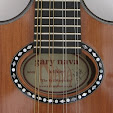
The soundhole is oval so I had to make up a jig in order to cut the channel for the rosette and the hole.


Being oval, each piece of mother of pearl had to be shaped individually to fit.


For the sides I’ve made up the external mould in four sections. It’s a bit odd cutting the sides into short sections before bending them, you keep double checking before sawing them! The back and sides are being made from some really beautiful English walnut.

Once the sides were bent, the four pieces are joined together by blocks of wood. The tail block is made from plywood. This going to have a hole drilled through it for a jack socket and the tail-piece attached to it; ply is the obvious choice so that it doesn’t split.


These heavy duty rubber bands and strips of plywood are a very effective way of clamping the awkward shape of the sides into the mould. Also they help to keep the overall weight of the mould down. The mould plus a dozen clamps gets extremely heavy and you run the risk of dropping the lot as you work on the sides.

All the other blocks are made from Honduras Cedar; it’s both very light and extremely stable. The linings will also be made from Cedar. Another reason for using Honduras Cedar or “Cigar box cedar” is that it gives the inside of the instrument a nice aroma; how’s that for attention to detail, worrying about how your instrument smells!

Labels: Building the Mandocello


 I won’t be able to make the delivery date and can only apologise profusely. You can see that it’s going to be a beauty and, hopefully Andy will agree, well worth the wait.


 I’ve just got hold of this book Blue Guitar by Ken Vose. I’ve been after it for a few years, but it’s always so expensive, fortunately I got this for a good price on eBay. There are 21 arch top guitars (all blue) custom built by luthiers for a collector. There are some fantastic instruments here; a very inspiring book! I must get on with Andy’s.............