Monday, October 06, 2008

Cittern Completed

I mentioned awhile ago that I’m often asked, “how long does it take to make a guitar?” All of my recent instruments have been custom built and all have had unique specifications. So, for me there is no typical build.
I have tried to answer the question by logging how much time I spent building this cittern. The last time a mentioned the cittern I was up to 75 hours and ready to start spraying.

Shaping the underside of the bridge to fit the soundboard’s arch.

Lacquer removed to allow gluing.
Since then, the cittern has been sprayed and polished, the bridge made and glued on (always a nerve wracking procedure!) and set-up. So now, I think that I can call the cittern complete.


“How long does it take to make a guitar?”
“This one, 125 hours!”
Take a look on YouTube.

Labels: ,

Friday, August 22, 2008

75 Hours...


Well, all the construction work is now done and the cittern is ready to lacquer. All the woodwork plus the preparation for spraying has taken 75 hours so far. It will be interesting to see how long the finishing process takes. I normally spray 3 coats of lacquer a day and then spend an hour or two the next day sanding it down; the instrument will get 20+coats!

Pretty stuff!


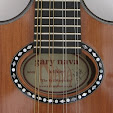
Above you can see the Paua shell rosette that I made for Andy D. I haven’t used Paua in a rosette for quite awhile and had forgotten how pretty it can look.

The head overlay below is Snakewood; it’s clear why it’s called that. This is the first time that I’ve used it; it’s incredibly hard and dense and sands to a silk like texture. It would make a great fingerboard for a fretless instrument.

Labels: , ,

Friday, August 08, 2008

So how long does it take to make a guitar (Cittern) Part 4?


Now I’m up to 52 hours. Those 12 hours of work, since the last entry, have been just on the bindings and purflings. As you saw with the mandocello, this shape is a bit tricky: some of the rebates for the bindings and purflings have to be cut by hand; there are 56 separate pieces and 5 mitres that have to be carefully cut.


I always use wood (rather than plastic) for the bindings, therefore each piece has to be carefully bent on the bending iron to fit. Also I now tend to make up my own purflings from coloured veneers. So although it takes awhile you can see why - I hope!


What next?

During the initial stages of a build you can work on various components separately, but as the build progresses those components converge and you have to spend less time per working day on any one instrument. Using the cittern as an example; you fit and glue one piece of binding, you then have to wait a few hours for the glue to set before working on the next piece. The mandocello is still being polished so that gets an hour or two a day. So, you need to start the next one.

Remember the photo of the Snakewood? Well, I’ve just started some preparation for that guitar. This one is for yet another Andy, I seem to know so many Andy’s! Anyway this guitar for Andy D will have Indian Rosewood back and sides and a stripe of paua shell going down the centre of the back.

Having glued up the back and taken it down to 2.5mm I had to cut a slot 1.3mm deep and 3.7mm wide to take the shell and lines of sycamore and rosewood. One of the challenging aspects of instrument making is that you work to engineering tolerances in a material that its maker didn’t design it to be used in such a way!

The slot had to be 3.7mm wide, my nearest router cutter is 3.2 mm. You can’t force something like this so the slot has to be spot on and you have to allow room for the adhesive too. If you force it, you split the back - you only make that mistake once!


The first cut is straight forward, clamp a straight edge to the back and make sure that the router is firmly held against it and away you go. The second cut is trickier, how do you move the straight edge 0.5mm and keep it parallel to the first cut? Answer, you don’t! After some head scratching I used some strips of heavy duty tape stuck to the side of the router’s base. Each strip was 0.17mm thick so this allowed me to slowly increase the width of the slot until it reached the perfect width.

Links

You can see that I’ve added a few more links to the side bar. One is for the “UnpluggedShop” to quote from it, “This site is about working with hand tools as a hobby and is dedicated especially to computer programmers, scientists, clergy, business administrators, truck drivers, CEOs, undertakers and those of all professions who need to get out more and get a life doing something relaxing with their hands. That is what Therapeutic Woodworking™ is all about.”


There is some wonderful stuff there for anyone interested in fine woodworking. I’m pleased that they find my blog interesting enough to track!

There is also a link to a forum called Just for Luthiers - one of many forums on the Acoustic Magazine website. I started contributing to it a while ago and there can be interesting debates about guitar construction. However, it occurs to me that forums such as these and the internet in general leads to a homogeneous world of lutherie where, just because large US manufactures do something, everyone else has to follow. What many fledgling guitar makers do not take on board is that a manufacturer of guitars (or any other consumer product) will usually evolve a technique of construction that suits there manufacturing requirements and create spin around it to justify its use. Individual luthiers do not have these constraints and should be constructing instruments that reflect their creativity and ingenuity. If I want inspiration I look to past masters or original thinkers such as Andy Manson and not the major US companies.

Labels: , , ,

Thursday, July 31, 2008

So how long does it take to make a guitar (Cittern) Part 3?

Well, I’m now up to 40 hours and you can see that soundboard, back and sides are all together.


Fixings the sides together on this shape takes a fair bit of time as there are small blocks shaped to fit inside each point and the neck block has to be exactly right to accommodate the cutaway and ensure a smooth transition from neck to body. As Ruaridh wanted to limit the use of tropical hardwoods in his instrument, you can see that the linings and blocks are all made from spruce.


The tail-block is plywood, less prone to splitting if you have a 12 mm hole for a jack socket. Fixing the sides together on this instrument probably took two hours longer than on a guitar. You can see that the purfling is now going on...


Raymond Burley

You may have heard of Ray, he is a highly acclaimed classical guitarist. If he is playing near you must go and see him. We saw him recently in concert near, Oxford and his playing is superb. He also plays with Gordon Giltrap and they have a great album out together called “Double Vision.”
If you have been following my blog for a while you may remember that a good 18 months ago I lent my friend Andy, my Classical “demonstrator” which I never got back as he bought it from me! Anyway, Andy has guitar lessons from Ray Burley and over that period of time Ray has heard it develop and played it a fair bit. So, I was absolutely delighted when Ray put a favourable comment about my work on his website.


Mandolin Jack Flat


Talking of good music, check out Mandolin Jack Flat on YouTube. He is a friend and client - I’ve done repair work on few of his instruments. He has put together some great Americana music and videos.

Labels: ,

Tuesday, July 15, 2008

So how long does it take to make a guitar (Cittern) Part 2?


If you saw one of my previous posts, you will know that I’m logging the time that I’m taking constructing Ruaridh’s cittern, so that I can answer the above question realistically.

Well, I’m up to 15 hours and here’s what has been done so far.
The neck blank has been worked on: laminated together, head joint made, carbon fibre reinforcement strips inserted and the slot for the adjustable truss rod done. The head overlay complete with pearl “N” has been glued on and the head shape cut out.


The sides are bent, back joined and taken down to its final thickness. The soundboard has also been joined and taken down to a bit over its final thickness and the rosette inlaid and cleaned up.

The time that I’m logging is the time that I’m hands on, doing practical work. What I’m not taking into consideration is design and development time.


This cittern being so what unorthodox has taken a fair bit of thought. The Rumsfled jig has been back in action, have a look at this if you’re interested.....


The Red Mandolin


You saw the multiple piece mandolin back in the last post. I’ve decided to use a Redwood soundboard for this one, so that all of the woods used are of a reddish hue; hence its name, the Red Mandolin.


I’ve just made up the rosette.


I mentioned a while ago our trip to Italy to visit Cremona and the Museo Stradivariano. One stunning violin, a copy of the Stradivari “Hellier” violin, by Sacconi stood out, this had pearl inlay of dots and diamonds around the outside. This motif was also used by another luthier that I greatly admire; the 19th century English guitar maker Louis Panormo. I’ve always wanted to make one of these rosettes, so this seem the right time!
Below you can see the sequence of making it, the 3mm diameter dots are bought in but all the diamonds (6 x 3 mm) I cut by hand.


Cutting 2.6mm wide strip from pearl blanks


Precautions from dust


Jig to cut angle


Careful positioning


Filling with ebony fibres and epoxy


Mandocello


The mandocello has been strung up and the tailpiece successfully tested. So it’s now being French polished. In this day and age of sustainability and various environmental issues, French polishing is probably as green as it gets. You are using shellac which is a secretion from an insect and harvested from the bark of the trees where it deposits it to provide a sticky hold on the trunk. Alcohol as a solvent, pumice powder (from volcanoes) as a filler and its all applied by a pad made up from cotton waste and old well washed white T-shirts. To stop the pad sticking olive oil is used as a lubricant. As a I say as green as you can get.
If you want to know more about French polishing guitars, there is great on-line guide/tutorial by Orville and Robert Milburn.


Labels: , , ,

Sunday, May 25, 2008

Binding the Mandocello and beginning a Cittern

Mandocello Update


The body of the mandocello is now together: this is the first time that I’ve used this shape and it’s not until you’ve got the body together, that you get a real feel of what the finished instrument will be like and I’m really pleased with the way it’s turned out. This is going to be a stunner!!

With the body together the bindings and purflings are next. The mandocello has 29 separate pieces that make up its purflings and binding so it’s quite a time consuming process. A rebate is cut around the edge for the bindings and purfling and this is done with a hand-held router.

The problem that I encountered with this shape is that the point of the cutaway is very thin and the back is curved, so the flat base of the router wobbles and the rebate can’t be cut accurately. So, at this point I thank my old tutor, Hebert Schwarz, who made me do everything by hand and get out my purfling cutter that I made about thirty years ago!


The purfling cutter is like a cutting gauge and allows you to cut a line parallel to the back or to the sides.


Once you’ve cut the line the rebate is chiselled out by hand.


There are so many websites that show guitar makers (notice I didn’t say luthiers) using jigs and machines for every operation. If you want to master the art of being a luthier you need to develop skills and know how to do things properly by hand, so that when your jigs and machines fail you, you can still get the job done!
Instruments progress in fits and starts, the purfling and bindings tend to take a long time to, you glue one piece on wait for it to dry, do the next etc.


So whilst this process is under way, I’m starting the preparation for Ruaridh’s cittern………


So how long does it take to make an instrument?

This is a question that I’m often asked; I always reply, “at least 100 hours.” The truth is, of course, I’ve got no idea! Last year I was listening to a Radio 4 program: “Malcolm McLaren salutes the talent of Christian Dior.” One of the things that he mentioned was how long it took to make a Christian Dior dress. I can’t remember the exact time but it was literally hundreds of hours (350 rings a bell!). My reaction was surely it can’t take longer to make a dress than a guitar! So I thought that I should actually log how much time it takes. The instrument that I’m going to log is the cittern that I’m making for Ruaridh. This will be an interesting build (aren’t they all!) as he wishes me to minimize the amount of tropical hardwood that I use and for this instrument it will only be the bridge and fingerboard that will be made from ebony, all the rest will either be spruce or temperate hardwoods such as walnut and maple.
Below you can see the neck blank starting to take shape. I can’t use mahogany as it’s a tropical hardwood and the usual alternative for a neck is maple. The cittern will have 10 tuners, so I wanted to keep the weight down and maple is much denser than mahogany. So, you can see my answer below, the neck will be laminated from maple, walnut and a green stained veneer.


I always laminate my necks as I believe the resulting neck is much more stable. The use of walnut cuts down on the overall weight as it is much lighter than maple.

Also the sides have been taken down to 2mm thickness, bent and fitted into the mould. Yes, it is the same shape as the Mando!

So far five hours work.....................

Labels: , ,