I’M GARY NAVA, A PROFESSIONAL LUTHIER MAKING MANDOLINS AND GUITARS BY HAND, TO THE HIGHEST STANDARDS, IN MY ANALOGUE WORKSHOP. HERE ARE VARIOUS TALES FROM MY WORK BENCH.
Sunday, August 29, 2021
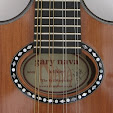
Twin-Point, Flat-Top Rosette
What with all the arch-tops and e-mandos that I’ve been building
recently, I’ve not had the need to make a rosette, as there hasn’t been a sound
hole to put it around! I’ve always enjoyed making rosettes so I’ve really been
looking forward to making one for the new twin-point and here it is……..
Whenever I get a visitor to the workshop, they’re always intrigued by how the sides are shaped. Well here’s the answer! For this instalment of the “Parlour Guitar: design & construction” videos, I thought that I’d show you how the sides are bent. The video’s a bit long, but I didn’t want to leave out any important information for all of you budding luthiers!
Antiques Road Show?
Well not quite! I was delighted to get some photos from Dave of an early Nava! I made this classical guitar in 1979 and remember it well. It was originally sold via the London Guitar Gallery for £200 in 1979 and Dave bought it second hand from the Camden Lock Music Shop in 1983 and has been playing it ever since! The guitar was built during my last year at the London College of Furniture and was the 13th that I made. The back and sides are made from Brazilian Tulipwood; I remember going to a wood yard to buy some mahogany boards for necks and saw this discarded, tatty, spilt board.
I had a small plane with me so I took a few shavings off the surface and claimed it!! I could only get narrow pieces out of the board; hence this guitar has a three-piece back. Oh how I wish I had some more of this beautiful wood! The rosette is also interesting, it was one of three that I made to this design.
All of the mosaic rosettes that we made at LCF were made from 1mm squares cut from pre-made strips. I felt that this didn’t give a fine enough pattern so I made some smaller mosaics by producing my own 0.6mm squares from veneers. Two of them were used in guitars (this one and its Indian rosewood sister) and here’s the third; in my workshop still unused. To be honest, this one’s a bit scruffy and was the prototype!
The shape of the guitar is similar to the one that I use on my classical today. At this time I was doing all the repair work for a Spanish guitar shop in the Fulham Road and I had to re-finish the back of a stunning Brazilian rosewood Manuel Contreras flamenco. At the time it was one the nicest guitars that I had ever handled and so I based my shape on it.
Richard’s Mandolin
Just in case you’re wondering if I ever glued that neck on! Here you see how the neck fits; it may look like a small joint, but there is over 21 square cm of surface area to glue so it’s strong enough!
Fast forward..............What I do like about making instruments with floating bridges and tailpieces is that you can get them set-up and playing before finishing. So now I have Richard’s mando playing it can be striped back down and be French polished.
Those eagle-eyed followers will note that my bridge design has changed- I’m using a separate saddle this time. Two reason, firstly less wood is used hence it’s lighter but more importantly it offers a relatively easy way to adjust the action. The saddle can be taken out and reduced in height or shims can be put underneath it, to raise the action. I’ve made up two saddles one bone the other ebony and once the mando has been played-in, Richard will be able to give me feedback about the tonal differences (cheers Richard!).
El Corazon I often get asked, “What’s the most difficult/challenging thing that you’ve done?” This rosette fits in that category!
I’ve just completed this rosette for El Corazon, Chris’s rosewood classical. The rosette was demanding on a number of levels: Chris commissioned this guitar in celebration of having a major heart operation, so clearly it’s a special instrument for him. The design needed to be more anatomical rather than twee; Amanda and I spent hours looking for suitable images, going right back to my father-in-law’s old copy of Leonardo’s Movement of the heart and blood! And below you’ll see how tricky it was to construct.
Firstly all the hearts had to be cut out of some pink ivory and I was very pleased that I managed to get them all virtually identical. They were then inlaid in to some Macassar ebony. Once the hearts were glued in, the ebony was cut into a circle. Red and black lines were inlaid into the soundboard and the wood in between them routed away to take the ebony ring. The soundboard, by the way, is a beauty: it’s a German spruce one that I bought 30 years ago when I was working at the London Guitar Gallery.
That’s a brief description of how it was made, but it took a ridiculous amount of time to make: I’m sure that I would have got a better hourly rate fruit picking at one of the local farms!! On the other hand, it is pretty and I’m rather proud of it!!
7 string ergonomic electric guitar!! In parallel with El Corazon I’m working on an electric guitar for Stefano, a Latin/Jazz guitarist. The two instruments couldn’t be more different. This one is based on the design of a Steve Klien ergonomic guitar. Stefano wants a 7 string, so although most guitars of this style are usually headless, we have decided to go with a head and mini tuners, as the hardware for a 7-string headless is prohibitively expensive. The head has to be small to cut down on weight so as you can see its shape is dictated by the old adage form follows function.It’s going to have a straight thru’ neck and here you can see the central core with the body halves ready to be glued on. Not wishing to blow my own trumpet, there aren’t many luthiers about who would be willing to take on such diverse commissions and as I have said before, all of these experiences help you grow as a craftsman/designer/luthier.
Interesting website If you’re interested in early romantic guitars this Japanese luthier has an interesting site. Click here for Crane guitars.
Acoustic magazine The article about me will now be in issue 34. Order your copy now!!
I’m currently working on a matching pair of instruments: a classical guitar and a baritone ukulele. They will have sinker redwood soundboards with Pink Ivory rosettes. Pink Ivory is an African hardwood and a quick google comes up with quotes like, “rarer than diamonds” or “the sacred wood of the Zulus.” So it’s quite special stuff!
I thought I’d show you how the rosettes were made. After some initial design work in collaboration with the clients and some testing to see how tightly I could bend rope purflings, the Pink Ivory was sliced into 2mm strips and glued together using waterproof Tite-Bond.
Channels were routed out in the soundboards, the rope purfling bent and glued in place.
I then glued a sheet of paper to a piece of plywood and the pink ivory to the paper using hide glue so that it could be removed later on in the process.
Then using my router, with a circle cutting jig that I’ve made, the Pink Ivory rings were cut out.
As the Pink Ivory was glued down with hide glue, I could then remove the rings from the paper......... And hey presto two beautiful Pink Ivory rosettes! More on these special instruments later.
Hi, I make mostly mandolins and guitars, entirely by myself and by hand. Although I’m based in the Norfolk Fens, my instruments can be found all over the world. I made my first guitar when I was 14 and during the 1970s studied luthiery at the prestigious London College of Furniture. I’ve been making them ever since!


 It’s going to have a straight thru’ neck and here you can see the central core with the body halves ready to be glued on.